We wrapped up our stay in Atlanta with a baseball game at Turner Field, watching the Braves lose 6-5 to the Florida Marlins. Being in Atlanta, we were rooting for the Braves (since they weren't playing a California team, hehe!), so it was a little disappointing that they didn't win.
Although all baseball parks have something in common, each one has something unique as well, making each visit something to look forward to. Traveling through this part of the country, at this time of year, we are hoping to hit at least three or four more before heading back west.
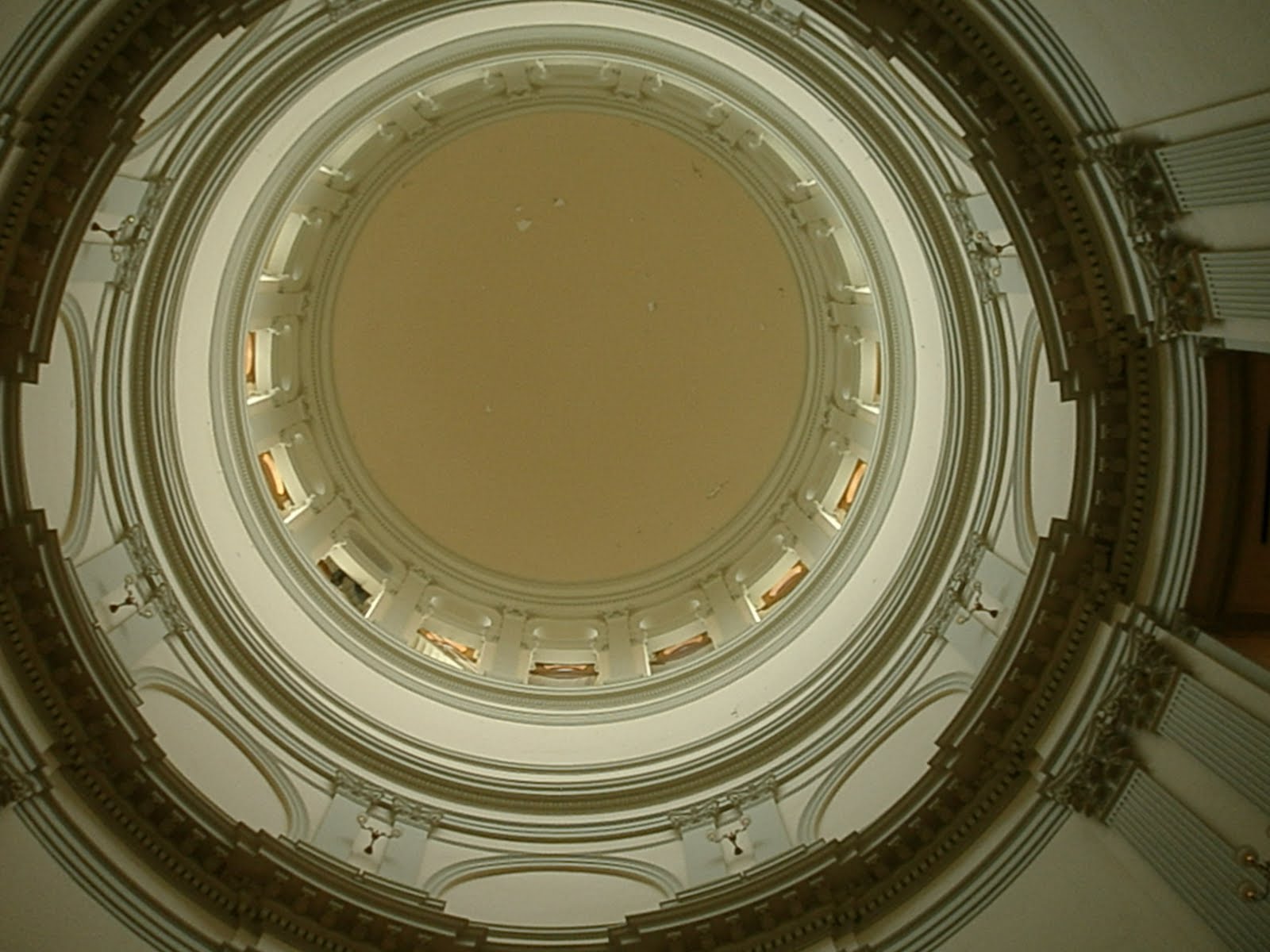
There was so much to see in Atlanta, I'm sure we didn't do it justice with the few days we were there, but of course visiting the Capitol was high on our list. The day we visited was very busy. Not only is this a working capitol, with the offices of the governor, lieutenant governor, and secretary of state on the second floor, and the General Assembly meeting on the third floor, there also happened to be an expo on ecology in full swing on the first floor. The place was packed, which made getting photos without somebody in them most difficult.


Like many U.S. state capitols, the Georgia State Capitol is designed to resemble the Classical architectural style of the United States Capitol, in Washington, D.C., and has been named a National Historic Landmark. It is listed on the National Register of Historic Places, and houses a museum, in existence since 1889, with extensive collections representing the natural and cultural history of Georgia. Native American artifacts, animals, rocks and minerals, and fossils illustrate the diversity of the collections.
If you find yourself in Atlanta, it would be worth your while to make a stop at the Jimmy Carter Presidential Center, located on 37 acres of parkland two miles from downtown Atlanta. In 2002, President Carter received the Nobel Peace Prize for his work "to find peaceful solutions to international conflicts, to advance democracy and human rights, and to promote economic and social development" through The Carter Center.
I think I am not alone when I say that my appreciation for Jimmy Carter has grown, and continues to grow, since he left office. His all-around peace keeping and humanitarian efforts that continue to this day have led him to be widely renowned as one of the most successful ex-presidents in US history. Many credit Carter's efforts at Camp David, which brought peace between Israel and Egypt, with bringing the only meaningful peace to the Middle East.


A strong supporter and activist for human rights, Jimmy, along with wife Rosalyn, have devoted their lives to improving the living conditions of people around the world. The Carter Center believes all people are entitled to basic human rights. These rights include political rights, such as peace, freedom, and self-governance, as well as the social rights of health care, food, shelter, and economic opportunity. President and Mrs. Carter have intervened with heads of state on behalf of human rights defenders and victims for more than 20 years. They often take their human rights concerns to heads of state in personal meetings and through letters.
This country was lucky to have a president who really made human rights his priority, and whose work didn't stop when he left office.
While in Atlanta we took the time to visit the Martin Luther King, Jr. National Historic Site. The momument consists of several buildings surrounding MLK Jr.'s boyhood home on Auburn Avenue, a visitor's center, and the original Ebenezer Baptist Church where King and his father, MLK, Sr. both pastored. A tour through Freedom Hall takes you through King's birth and childhood years, his call to the Civil Right's movement, his quest for non-violence, and his tragic death.
King was an activist and prominent leader in the African American civil rights movement, using nonviolent methods following the teachings of Mahatma Gandhi. In 1964, he became the youngest person to receive the Nobel Peace Prize for his work to end racial segregation and racial discrimination through civil disobedience and other nonviolent means. By the time of his death in 1968, he had refocused his efforts on ending poverty and stopping the Vietnam War.
King was assassinated on April 4, 1968, in Memphis, Tennessee. He was posthumously awarded the Presidential Medal of Freedom in 1977 and Congressional Gold Medal in 2004; Martin Luther King, Jr. Day was established as a U.S. federal holiday in 1986. In 1977, a memorial tomb was dedicated, and the remains of Martin Luther King Jr. were moved from South View Cemetery to the plaza that is nestled between the center and the church. Mrs. King was interred with her husband on February 7, 2006.
It was an honor and a privilege to spend the day reflecting on the meaning of Martin Luther King, Jr.'s life, his words, all he stood for, and to embrace the concepts of peace, acceptance, non-violence, and equality.
With an eventual goal of reaching Washington D.C. by May 1st, and having about 3-4 weeks to get there, we decided to take a meandering path, making as many stops along the way as felt comfortable. After leaving Jacksonville, we drove just 170 miles northeast to Savannah, Georgia, where we spent three days taking in the sights, sounds, smells, and impressions of this very vibrant and interesting Southern city. No doubt we could have spent three months and still not seen enough, but we did what we could in our allotted time.


Savannah is lush with plant life. Everywhere you turn is a tree, a shrub, a flowering plant, with Spanish moss hanging from huge trees that look to be hundreds of years old. The architecture of the city reflects its Southern heritage with its many plantation style homes and buildings. Beautiful churches seem to loom on every corner, and history is captured in the monuments, plaques, and statues sprinkled throughout the city streets.
We were even able to capture a little taste of Southern cooking, vegan style. Dan and I ordered two sandwiches to share, one filled with Fried Green Tomatoes, and the other with a Black-eyed Pea veggie pattie. We stopped in a peanut shop along the Riverwalk and bought a can of boiled peanuts, otherwise known as Goober Peas. It really is fun exploring the traditions, cuisine, and history of our very diverse country!
Established in 1733, Savannah was the first capital of Georgia, is the birthplace of Juliette Gordon Lowe (founder of the Girl Scouts of America), and the downtown area with its 22 park-like squares is one of the largest National Historic Landmark Districts in the United States. Horse-drawn carriages and trolleys line the streets waiting to take visitors on tours of the city. Bonaventure Cemetery, featured in the book and movie "Midnight in the Garden of Good and Evil", is a landmark not to be missed, a former plantation and the final resting place for some illustrious Savannahians.